
When natural disasters strike, traditional communication networks like cell towers and the internet often fail, leaving people isolated when they need help most. Reliable emergency communication tools are essential to bridge this gap, ensuring organizations and individuals can stay in contact during a crisis.
Software Solutions for High-Stress Environments
During an emergency, the tools you use must be intuitive, fast, and capable of operating under severely limited network conditions.
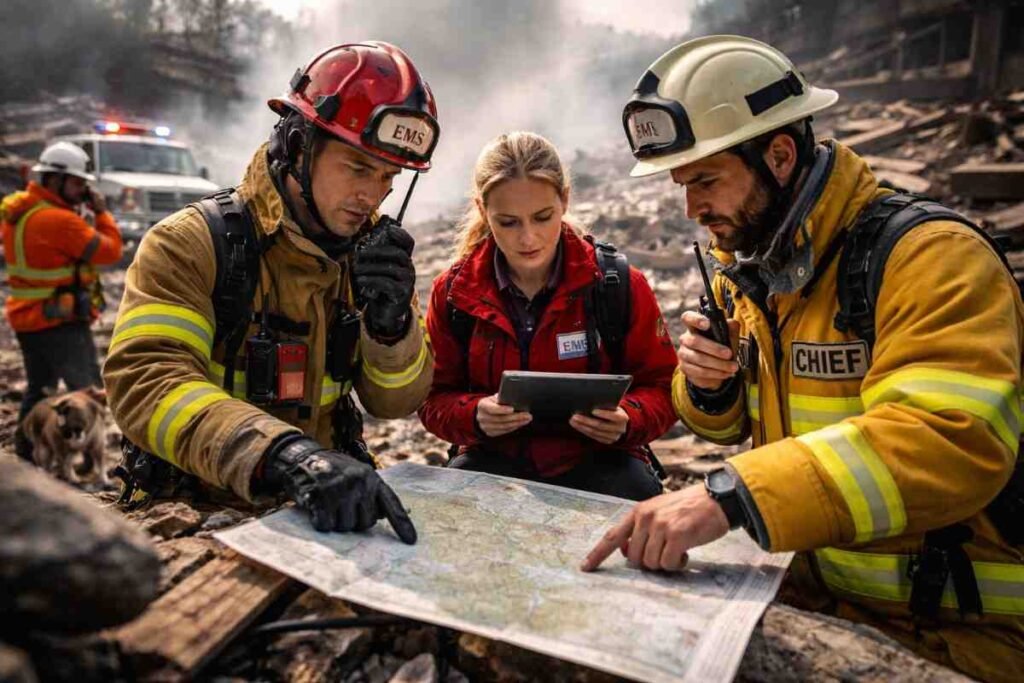
Offline Mapping Tools
Navigating a disaster zone requires accurate geographical data. However, standard GPS applications rely on active cellular connections to render maps and track locations. Offline mapping tools solve this critical problem by allowing users to download detailed regional maps ahead of time.
Applications or specialized tactical mapping software let emergency responders and corporate employees find safe evacuation routes without an internet connection. These tools often include topographical data and community-updated hazards.
Having this information stored locally on a device proves vital when main roads are blocked by debris or flooded by storm surges. Teams can navigate around hazards safely, ensuring they reach designated rally points without relying on a fragile cellular signal.
Emergency Notification Apps
When every single second counts, broadcasting accurate information quickly is crucial. Emergency notification applications allow organizations to send mass alerts across multiple channels simultaneously. These platforms push urgent notifications via SMS, email, voice calls, and desktop pop-ups to ensure the vital message gets through to everyone.
High-stress environments demand simple, one-touch activation systems. System administrators can use these apps to poll employees on their current safety status, quickly identifying who needs immediate medical or evacuation assistance. Many of these applications also feature geofencing capabilities.
This allows organizations to send targeted alerts only to employees located within the specific geographic danger zone, preventing unnecessary panic for staff working safely in other regions.
Best Practices for Organizations
Technology alone cannot save a disorganized team. Organizations must develop clear, practiced protocols long before a disaster ever occurs.
Building a Robust Protocol
A strong emergency response plan assigns specific roles to key team members. Everyone in the organization should know exactly who to contact and which tools to use during a crisis. Business leaders must conduct regular emergency drills to test these systems. Running practice scenarios reveals gaps in the communication chain and helps employees build muscle memory for operating emergency software under pressure.

Protecting Personnel and Data
Human safety is always the primary concern in any disaster scenario. Your communication plan must account for remote workers, traveling staff, and in-office employees. Establish a primary communication channel, along with two distinct backup methods.
For example, if the primary corporate messaging app fails, the team shifts to SMS. If regional cellular networks drop completely, leadership might utilize a designated satellite walkie-talkie or similar offline hardware to coordinate with local emergency services.
Protecting sensitive business data is another critical factor that organizations often overlook during physical emergencies. Disasters leave physical servers and office locations vulnerable to water damage, fire, or opportunistic theft. Companies should rely on secure, encrypted cloud backups maintained in separate geographic regions. Use an airtag to track critical equipment.
Furthermore, emergency communication protocols must include specific steps for IT personnel. These tech leaders need to know how to remotely lock down local networks and secure company data from unauthorized access while the physical office is compromised.
Conclusion
Now that you have a better understanding of the importance of disaster recovery planning for businesses, it’s important to take action and implement these strategies in your own company.