Kids are naturally fascinated by things that fly. From birds darting across the sky to massive commercial jets soaring above the clouds, the magic of flight captures the human imagination from an early age. How do these heavy objects actually stay in the air? That is exactly where the science of aerodynamics comes into play.
Teaching this branch of physics does not require dry lectures or complicated math equations. You can use hands-on STEM activities to bring these invisible forces to life right in your living room or classroom. By building, testing, and tweaking their own flying creations, students learn about the four main forces of flight: lift, drag, thrust, and weight. They see firsthand how a slight change in shape alters the way an object moves through the air.
If you want to spark a love for science and engineering, hands-on learning is the absolute best approach. This guide covers five highly engaging activities designed to teach the core concepts of aerodynamics while keeping learners completely entertained.
The Classic Paper Airplane Challenge
Almost everyone has folded a paper airplane at some point. This simple pastime is actually a perfect introduction to aerodynamic engineering. By turning a basic folding exercise into a structured science experiment, kids can learn how minor design tweaks impact flight performance.
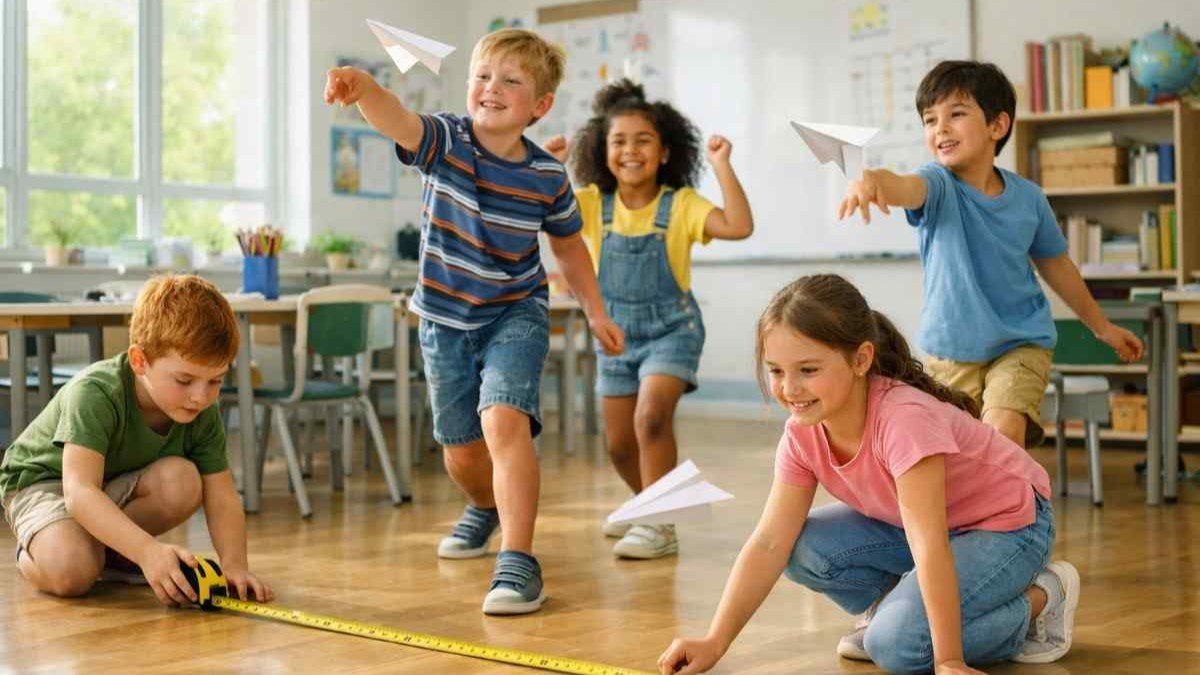
To set up this challenge, gather a stack of printer paper, a tape measure, and some masking tape to mark a starting line. Have your young engineers design three different types of paper airplanes. They might create one with wide wings, one that is long and narrow like a dart, and one with blunt edges.
Once the planes are folded, it is time for the flight test. Have the kids throw each plane from the same starting line and measure the distance. Ask them to observe how each plane behaves in the air. Does the wide-winged plane glide smoothly?
Does the narrow dart fly faster but drop quickly? Introduce the concepts of lift (the upward force) and drag (air resistance) to explain why different shapes perform differently. Encourage them to modify their designs by folding the wingtips up or adding a paperclip to the nose to see how weight distribution affects the flight path.
DIY Cardboard Wind Tunnel
Professional aerospace engineers use wind tunnels to test how air flows around aircraft. You can recreate a small-scale version of this critical testing environment using basic household items. This activity allows kids to visualize air currents and understand aerodynamic shapes.
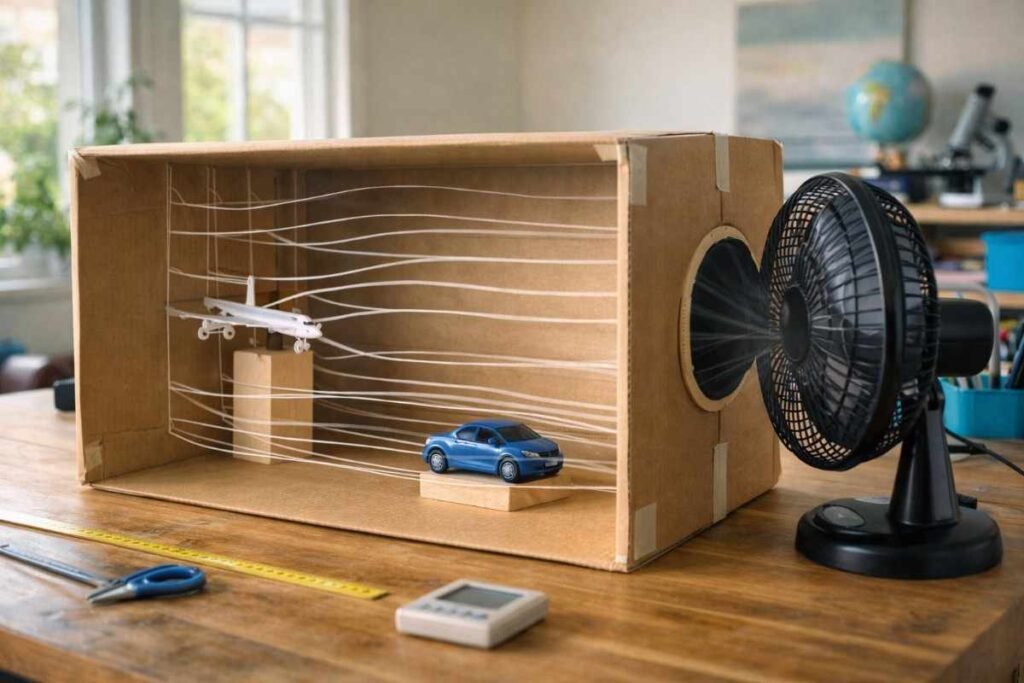
You will need a large cardboard box, a small box fan, clear plastic wrap, and some string. Cut off the two ends of the cardboard box to create a hollow tube. Cut a large rectangular viewing window on one side of the box and cover it tightly with the clear plastic wrap. Place the box fan at one end of the tunnel so it blows air straight through the box.
Now, gather various small objects to test. You can use a tennis ball, a toy block, and a streamlined shape made out of modeling clay. Tape a few short pieces of light string to each object. Place an object inside the wind tunnel and turn on the fan.
The strings will show exactly how the air moves around the item. Students will quickly notice that the strings flutter wildly behind flat, bulky objects due to turbulent air, while the strings lie flat against the streamlined clay shape. This perfectly demonstrates why vehicles and aircraft feature smooth, curved designs.
High-Speed Balloon Rockets
Aerodynamics is not just about wings and gliding. It also covers the concept of thrust, which is the force that propels an object forward. The balloon rocket experiment is a fantastic, high-energy way to demonstrate thrust and Newton’s Third Law of Motion, which states that for every action, there is an equal and opposite reaction.

For this activity, you need a long piece of smooth string, a plastic drinking straw, tape, and a few round balloons. Tie one end of the string to a heavy chair or doorknob. Thread the loose end of the string through the plastic straw, and then pull the string tight and tie it to another object across the room.
Blow up a balloon, but do not tie the end. Simply pinch it shut so the air cannot escape. Tape the inflated balloon to the plastic straw. When you are ready for launch, let go of the balloon’s end. The air rushing out of the back pushes the balloon forward along the string track at high speeds. Try this with balloons inflated to different sizes to see how the amount of air affects the distance and speed of the rocket.
The Parachute Drop Experiment
While airplanes need to move quickly through the air, parachutes are designed to do the exact opposite. They maximize air resistance to slow an object down. Building miniature parachutes teaches kids about drag and gravity in a very practical way.
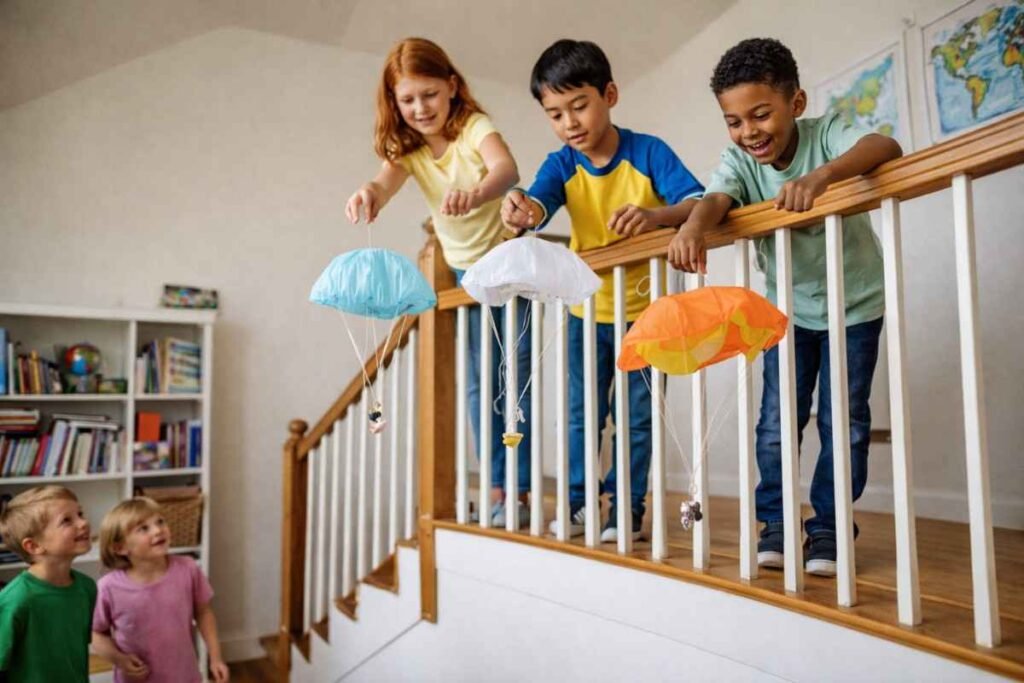
Gather materials like coffee filters, plastic grocery bags, tissue paper, light string, and a few small action figures or metal washers to serve as the payload. Cut the parachute materials into large squares or circles. Punch four small holes around the edges of the material and tie a piece of string to each hole. Attach the other ends of the strings to your payload.
Find a safe, elevated spot to drop the parachutes, like the top of a staircase or playground equipment. Drop a payload with no parachute, and then drop one attached to a parachute. The difference in fall speed is immediately obvious. Challenge the students to design a parachute that falls as slowly as possible. They will discover that larger surface areas catch more air, creating more drag and a safer landing for their payload.
Crafting Balsa Wood Gliders
Once kids understand the basics of lift, drag, thrust, and weight, they can move on to a slightly more advanced construction project. Building simple gliders introduces them to structural engineering and weight balance.

Balsa wood is incredibly lightweight and perfect for this activity. You can purchase balsa wood strips and thin sheets from a craft store, or buy a basic glider kit. Have the students assemble the fuselage, the main wing, and the tail stabilizers. This is a great time to discuss the history of flight and how early aviation pioneers built rudimentary model airplanes to test their theories before building full-sized machines.
When the gliders are assembled, do a few test flights. If the glider dips its nose and crashes, it is too heavy in the front. If it loops upward and stalls, it is too heavy in the back. Students can use small pieces of modeling clay attached to the nose or tail to perfectly balance the center of gravity. Watching their hand-built glider coast smoothly across the yard brings all the scientific concepts together into one rewarding achievement.
Taking Flight with STEM
Aerodynamics might seem like a complex topic reserved for college physics classes, but its foundational concepts are incredibly accessible. By participating in these STEM activities, young learners build problem-solving skills, learn to test hypotheses, and develop a deeper understanding of the physical world.
Gather your materials, set up your testing zones, and let the science experiments begin. The skills your students learn today could very well be the spark that inspires the aerospace engineers of tomorrow.